








India’s Top Export Markets: How Global Demand Is Reshaping Trade Flows
India’s Export Map Is Being Redrawn: What the Numbers Reveal
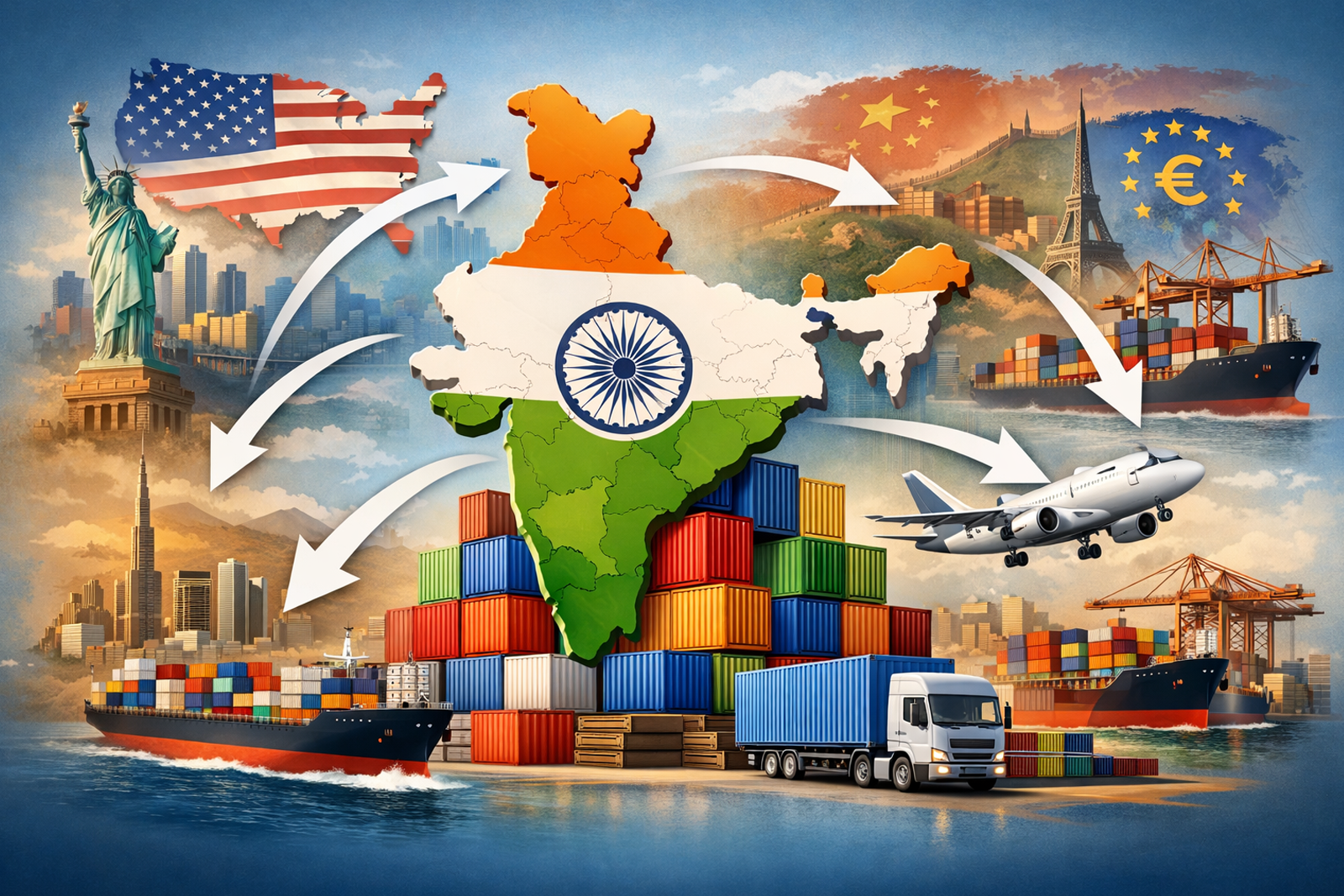
India’s trade story is entering a new phase. Once dominated by a small group of traditional partners, the country’s export destinations are now spreading across regions as companies respond to shifting consumer demand, geopolitical realignments, and new trade agreements. Recent data shows that while established markets remain vital, emerging economies are steadily gaining a larger share of India’s outbound shipments.
Traditional Buyers Still Matter
The United States and the European Union continue to rank among India’s most important export destinations, driven by strong demand for pharmaceuticals, engineering goods, textiles, and IT-related services. These mature markets provide stability and scale, allowing Indian manufacturers to maintain large-volume production and long-term contracts. However, growth rates here are moderating compared to newer regions.
Asia and the Middle East on the Rise
Exports to ASEAN nations, the Gulf region, and East Asia have accelerated in recent years. Electronics components, refined petroleum products, chemicals, and food items are finding wider acceptance in these nearby markets. Shorter shipping routes and expanding regional trade ties have helped Indian firms become more competitive, especially in price-sensitive segments.
Africa and Latin America Enter the Picture
Beyond Asia, Africa and Latin America are emerging as promising frontiers. Rising urban populations and infrastructure investment have boosted demand for automobiles, pharmaceuticals, and construction materials from India. Though these regions still account for a smaller share of total exports, their growth momentum suggests a gradual rebalancing of India’s global trade portfolio.
Policy, Logistics, and Strategy Drive Change
Government incentives for manufacturing, export-focused industrial corridors, and port modernisation have also played a role in reshaping trade flows. Companies are diversifying supply chains, reducing reliance on single markets, and tailoring products for local tastes abroad—moves that make India’s export sector more resilient in an uncertain global environment.
A More Diversified Trade Future
Taken together, these shifts point to a broader and more balanced export landscape. Instead of depending heavily on a handful of partners, India is building connections across continents, strengthening its position in global commerce and opening new pathways for long-term growth.
India’s Export Destinations Are Transforming: A Deep Dive into the New Trade Geography
India’s outward trade is undergoing a structural change. For decades, exports were concentrated in a few advanced economies that absorbed a large share of manufactured goods and services. Today, however, Indian companies are increasingly tapping newer regions, building multi-country supply chains, and targeting fast-growing consumer bases. This diversification reflects not only market forces but also policy initiatives, infrastructure upgrades, and global realignments in production networks.
Below is a detailed look at the major forces reshaping where India sells its goods—and what the changing map means for the future.
The Enduring Role of Established Markets
Despite diversification, traditional buyers remain the backbone of India’s export earnings.
-
United States and Europe: These regions continue to import pharmaceuticals, engineering products, apparel, gems and jewellery, and software-linked services from India.
-
Reliability and Scale: Large consumer bases and predictable regulatory frameworks make these markets crucial for high-volume exporters.
-
Slower but Steady Growth: While still dominant, expansion into these economies has become more incremental compared with the surge seen in emerging regions.
The presence of Indian companies in these mature markets also helps build brand recognition and compliance standards that can later be leveraged elsewhere.
Asia’s Expanding Share in India’s Trade Basket
Asia is becoming a central pillar in India’s export strategy.
-
ASEAN Countries: Electronics components, chemicals, agricultural goods, and automotive parts are gaining traction.
-
East Asia: Demand for industrial inputs and specialty materials has increased, linking Indian suppliers to regional manufacturing hubs.
-
Proximity Advantage: Shorter shipping routes lower logistics costs and reduce delivery times, making Indian products more competitive.
Growing cross-border investment within Asia is further strengthening these commercial ties.
The Gulf and Middle East: Energy and Beyond
The Gulf region has long been important for petroleum trade, but its role is now broadening.
-
Refined Fuels and Petrochemicals: These remain key export items.
-
Food and Consumer Goods: Rising populations and tourism-driven economies are increasing imports of processed foods, textiles, and household products from India.
-
Infrastructure Demand: Construction materials and engineering services are also finding new buyers as Gulf countries invest in urban development.
Closer economic partnerships and logistics corridors are reinforcing India’s footprint in this strategically located region.
Africa and Latin America as Growth Frontiers
Although smaller in absolute terms, these regions represent some of the fastest-expanding destinations for Indian exports.
-
Africa: Pharmaceuticals, two-wheelers, tractors, and packaged foods are in demand across multiple countries.
-
Latin America: Agricultural chemicals, auto components, and industrial machinery are carving out space for Indian firms.
-
Demographic Drivers: Young populations and rising urbanisation are creating sustained consumption needs.
Indian exporters view these markets as long-term bets, often establishing local distribution networks to deepen their presence.
Sector-Specific Shifts Are Rewriting Trade Patterns
Changes in what India sells are closely linked to where it sells.
-
Electronics and Hardware:Growing production capacity is opening doors in Asian and West Asian markets.
-
Pharmaceuticals:Regulatory approvals in multiple regions have allowed Indian drug makers to expand far beyond traditional buyers.
-
Processed Foods and Agri-Exports:Improvements in cold-chain logistics have made it easier to reach distant consumers with higher-value products.
-
Green Technologies:Components for renewable energy and electric vehicles are beginning to feature in India’s export mix.
As these sectors scale up, they naturally pull new geographies into India’s trading orbit.
Policy Support and Infrastructure Upgrades
Government initiatives are playing a supporting role in this transition.
-
Manufacturing Incentives:Schemes designed to boost domestic production encourage firms to target global markets.
-
Trade Agreements:Bilateral and regional pacts reduce tariffs and simplify market access.
-
Port Modernisation:Faster cargo handling and digital customs processes cut turnaround times, making exports more efficient.
-
Industrial Corridors:Dedicated freight routes link factories to shipping hubs, lowering transportation costs.
Together, these measures improve India’s attractiveness as a sourcing destination for overseas buyers.
Corporate Strategy: Diversification as Risk Management
For exporters, spreading sales across multiple countries is no longer optional—it is strategic.
-
Reducing Dependence:Firms aim to avoid over-reliance on any single market that could be disrupted by economic slowdowns or regulatory shifts.
-
Customised Products:Companies increasingly tailor packaging, standards, and product features to local tastes and rules.
-
Regional Warehousing:Setting up distribution centres abroad shortens delivery cycles and improves customer service.
Such moves enhance resilience in an unpredictable global economy.
What the New Export Map Signals for the Future
The evolving geography of India’s exports suggests a move toward balance rather than replacement.
-
Mature markets will remain central for high-value and regulated products.
-
Emerging regions will drive volume growth and open opportunities for newer industries.
-
Asia and the Middle East are likely to gain further prominence due to geographic proximity and expanding trade links.
Over time, this multi-directional approach could help stabilise export earnings and reduce vulnerability to regional downturns.
A Trade Network That Is Broader and More Adaptive
India’s export landscape is no longer defined by a narrow set of destinations. Instead, it is spreading across continents, industries, and income groups. By combining established partnerships with outreach to rising economies, Indian exporters are crafting a more flexible and future-ready trade network—one that mirrors the country’s ambition to play a larger role in global commerce.

About The Author
Soojin Das is a dedicated journalist with a strong focus on public affairs, governance, and grassroots reporting. With a passion for uncovering stories that matter, she brings clarity, accuracy, and depth to complex issues shaping communities across India. Her reporting spans politics, social development, education, and local civic concerns, giving readers a balanced and well-researched perspective. Known for her sharp news sense and ethical approach to journalism, Anita combines on-ground reporting with data-driven analysis and compelling storytelling. She has covered major policy announcements, elections, disaster response efforts, and community-led initiatives, ensuring that audiences receive timely and trustworthy information. Anita believes journalism plays a vital role in strengthening democracy and amplifying under-represented voices. Through interviews, investigative pieces, and human-interest stories, she aims to inform, engage, and empower readers. When not in the field, she closely follows media innovation and digital storytelling trends, continually refining her craft to meet the evolving needs of modern newsrooms.
Soojin Das | Journalist
You Might Also Like
-
Centre Urges Responsible LPG Use Amid Supply Concerns The central government has issued an advisory urging citizens to use Liquefied Petroleum ...
-
Indian LPG Carrier Safely Crosses Strait of Hormuz, Easing Supply Concerns An Indian liquefied petroleum gas (LPG) carrier has successfully cro...
Suggested Video