- Loading...
- Loading...


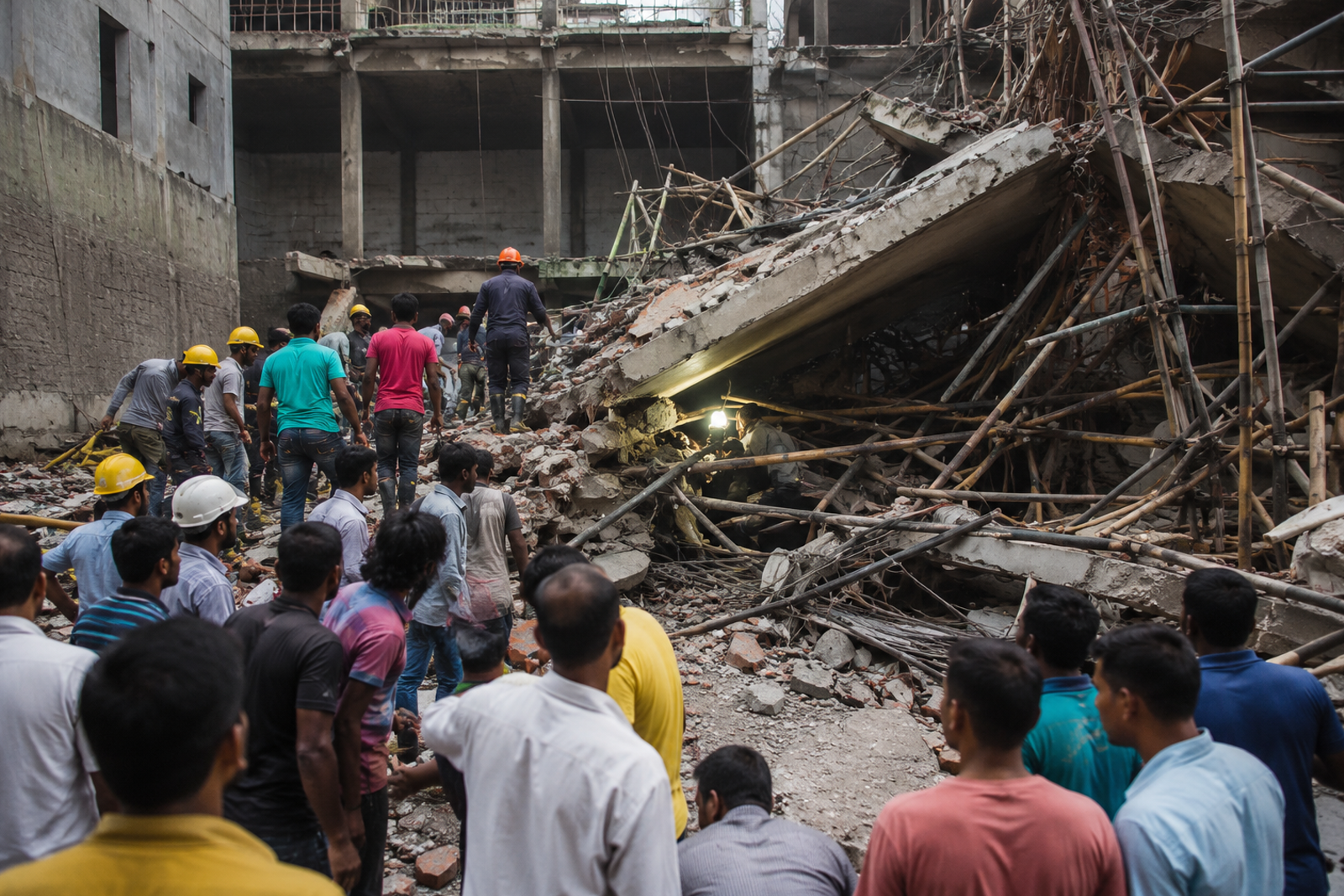
A major construction-related accident unfolded in Kolkata's Taratala area when an under-construction warehouse suddenly collapsed, leading to the deaths of five people and injuries to several others. The incident occurred during ongoing construction work, catching workers and nearby individuals off guard. The collapse sent concrete, steel, and debris crashing down within seconds, creating panic across the locality.
Emergency services were immediately alerted, and rescue personnel rushed to the site to begin relief operations. The tragedy has once again raised concerns about construction safety standards and compliance with building regulations in rapidly developing urban areas.
Teams from the fire department, disaster response units, police, and local authorities quickly reached the accident site. Heavy machinery was deployed to clear the rubble while rescuers searched for individuals who may have been trapped beneath the collapsed structure.
Rescue workers faced challenges due to the unstable debris and the risk of further structural failure. Despite these difficulties, operations continued throughout the day as officials worked to ensure that no victims remained trapped.
Medical teams were also stationed nearby to provide immediate treatment to the injured before transferring them to hospitals for advanced care.
Following the collapse, authorities initiated a detailed investigation to determine the exact cause of the accident. Experts are expected to examine the construction design, materials used, and adherence to safety norms.
Officials have indicated that any negligence found during the inquiry will be dealt with according to the law. Investigators will also assess whether the project had received all necessary approvals and whether proper safety measures were in place for workers.
The warehouse collapse has renewed discussions about the importance of strict monitoring of construction projects. Experts often emphasize that adherence to engineering standards, regular inspections, and worker safety protocols are essential to prevent such disasters.
Urban infrastructure projects continue to expand across metropolitan cities, making safety oversight more important than ever. Incidents like this highlight the risks associated with inadequate planning or lapses in supervision.
The tragic loss of lives has left families and local residents in shock. Authorities have expressed condolences to the victims' families and assured the public that rescue and investigation efforts will continue until all facts are established.
As Kolkata mourns the victims, attention now turns to accountability, safety compliance, and measures that can prevent similar incidents in the future.
A devastating structural collapse in Kolkata's Taratala area has left the city in mourning after an under-construction warehouse came crashing down, claiming five lives and injuring several others. The incident triggered an immediate emergency response, with rescue teams, firefighters, police personnel, and disaster management units rushing to the site to save those trapped beneath the debris.
The tragedy has once again brought attention to the critical issue of construction safety, particularly in rapidly growing urban centers where infrastructure projects are expanding at an unprecedented pace. As rescue operations continue and investigators search for answers, concerns are being raised about building standards, worker protection, and accountability.
According to initial reports, the under-construction warehouse collapsed unexpectedly during ongoing construction activities. Workers present at the site had little time to react as parts of the structure gave way, resulting in a massive pile of concrete, steel rods, and construction material.
Witnesses described hearing a loud crashing sound followed by clouds of dust that quickly engulfed the area. Local residents and workers nearby rushed toward the site before emergency teams arrived, attempting to help those caught under the rubble.
The sudden nature of the collapse left several individuals trapped, prompting an urgent rescue mission.
Authorities responded swiftly after receiving information about the accident.
Rescue workers worked carefully due to concerns that additional sections of the damaged structure could collapse. The operation required a combination of manual searching and mechanical excavation to locate survivors.
The collapse resulted in the deaths of five individuals, while several others sustained injuries of varying severity.
Authorities continued verifying the identities of victims and informing their families as rescue operations progressed.
Large-scale structural collapses often create dangerous conditions for rescue personnel.
Despite these obstacles, rescue teams continued efforts to ensure no one remained trapped.
Following the tragedy, authorities launched an investigation to determine the exact reason behind the warehouse collapse.
Experts are expected to conduct detailed assessments before reaching conclusions regarding the cause of the accident.
While official findings are yet to be released, investigators are likely to evaluate several factors.
Poor workmanship can weaken a building's structural integrity and increase the risk of collapse.
The use of low-quality materials may compromise strength and durability.
Errors in engineering calculations can place excessive stress on key structural components.
Construction materials stored improperly may create weight beyond the structure's capacity.
Inadequate monitoring and inspections can allow serious risks to go unnoticed.
Authorities have not confirmed any specific cause, and all possibilities remain under review.
The Taratala warehouse collapse has intensified discussions about construction safety standards across urban India.
Construction sites are inherently high-risk environments. Strict adherence to regulations helps protect workers and surrounding communities.
Essential safety measures include:
Experts emphasize that preventive measures are often more effective than post-incident corrective action.
The collapse has deeply affected residents and businesses in the Taratala area.
Many residents have urged authorities to conduct comprehensive safety audits of ongoing construction projects in the vicinity.
Whenever a major construction accident occurs, questions arise regarding responsibility and oversight.
The answers to these questions will play a significant role in determining any legal or administrative action that may follow.
Incidents like the Taratala warehouse collapse serve as reminders of the importance of safety-first practices.
Frequent inspections can identify weaknesses before they become catastrophic.
Workers should receive proper safety equipment and training.
Construction materials must meet approved standards.
Project records and safety compliance reports should be maintained accurately.
Well-defined emergency protocols can save lives during accidents.
Local authorities have assured the public that a thorough inquiry will be conducted. Officials have also emphasized that anyone found responsible for negligence will face appropriate legal action.
Government agencies are expected to review construction-related regulations and examine whether additional safeguards are needed to prevent similar incidents in the future.
Beyond the statistics, the collapse represents a profound personal loss for families who have lost loved ones. For injured workers, recovery may involve long periods of medical treatment and rehabilitation.
The incident highlights the risks faced daily by construction workers who contribute to the development of urban infrastructure. Their safety remains a critical responsibility shared by contractors, engineers, developers, and regulatory authorities.
The collapse of an under-construction warehouse in Kolkata's Taratala area stands as a tragic reminder of the importance of construction safety and regulatory vigilance. With five lives lost and several others injured, the incident has sparked urgent questions about structural integrity, workplace protection, and oversight mechanisms.
As rescue teams complete their operations and investigators continue their work, the focus will remain on uncovering the cause of the disaster, ensuring accountability, and implementing measures that can help prevent such tragedies in the future. The hope now is that meaningful lessons emerge from this heartbreaking event, leading to safer construction practices and stronger protection for workers across the country.

In today’s world of endless choices and digital noise, marketing is no longer just about promoting products — it’s about creating meaningful connections. Successful brands focus on building relationships rather than chasing transactions. Marketing that connects transforms audiences into loyal communities by earning their trust, understanding their needs, and delivering genuine value. When businesses prioritize people over promotions, marketing becomes more than strategy — it becomes a relationship built to last.

Odisha’s small businesses are entering a new era — where mobile apps, online payments, and e-commerce aren’t luxuries, but lifelines for growth and survival.

As India enters the second phase of its digital revolution, artificial intelligence and automation are not just transforming industries—they’re redefining what it means to work, earn, and adapt.

The conference brought together officials from ten central districts, including district collectors, tehsildars, registrars, and welfare officers, either virtually or in person.

We glorified sleepless nights, burnout, and exhaustion as signs of ambition. But when did working yourself to the edge become the definition of success?

Not everyone who thrives in tech writes code. Some design the very experiences that make technology human.







Leave Comments