- Loading...
- Loading...


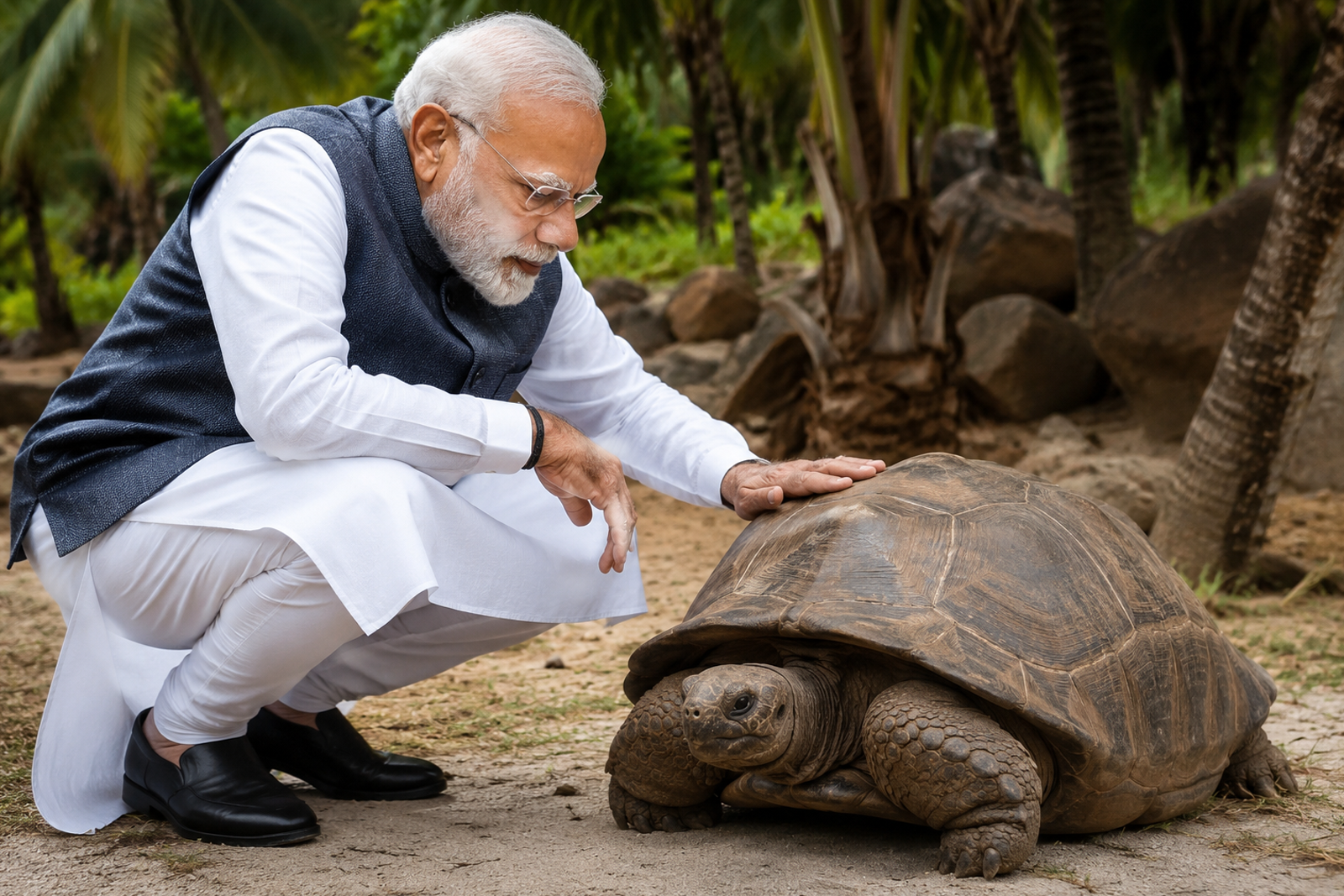
A fresh political debate has emerged after Prime Minister Narendra Modi visited the Giant Tortoise Enclosure during his official trip to Seychelles. While the visit was projected as part of India's commitment to environmental conservation and stronger diplomatic ties with the island nation, the Congress party strongly objected to the event. Calling it an example of "masterly hypocrisy," the opposition accused the government of highlighting wildlife conservation abroad while allegedly overlooking environmental challenges and biodiversity concerns within India.
Congress leaders argued that symbolic visits to conservation sites cannot replace meaningful action on environmental protection. According to the party, India continues to face issues such as deforestation, habitat destruction, pollution, and climate-related challenges that require immediate policy attention. The opposition claimed that the government should focus on addressing these domestic concerns before showcasing its environmental commitment on international platforms.
The criticism quickly gained attention on social media, where political leaders and supporters from both sides debated the significance of the Prime Minister's visit.
The Prime Minister's visit to Seychelles was aimed at strengthening bilateral relations between the two countries. Apart from discussions on maritime security, economic cooperation, and development partnerships, the itinerary also included cultural and environmental engagements.
The Giant Tortoise Enclosure is one of Seychelles' most recognized conservation attractions and symbolizes the country's efforts to protect its unique biodiversity. By visiting the site, India sought to highlight shared commitments toward sustainable development and wildlife conservation.
Supporters of the government defended the visit, stating that environmental diplomacy has become an important aspect of international relations. They argued that participating in conservation-related activities during foreign visits reflects India's broader commitment to protecting biodiversity and promoting sustainable practices across the globe.
Officials also pointed out that India has undertaken several initiatives related to renewable energy, wildlife protection, and climate action in recent years, making the criticism politically motivated.
The controversy once again reflects the sharp political divide between the ruling government and the opposition. While the Congress believes the visit sends a contradictory message, the government maintains that environmental conservation and diplomatic engagement can go hand in hand.
As political exchanges continue, the discussion has shifted beyond the Seychelles visit to broader questions about India's environmental policies, governance priorities, and the role of symbolic diplomacy in international relations. The issue is expected to remain part of the ongoing political discourse in the coming days.
Prime Minister Narendra Modi’s official visit to Seychelles has sparked a fresh political confrontation in India after the Congress party criticized his stop at the Giant Tortoise Enclosure. While the government described the visit as part of a broader diplomatic mission focused on strengthening bilateral ties, Congress alleged that the event highlighted a contradiction between the Centre’s international messaging on environmental conservation and its domestic record.
Describing the visit as an example of "masterly hypocrisy," opposition leaders argued that symbolic gestures abroad cannot replace comprehensive environmental action at home. The remarks have triggered widespread political debate, with supporters of the government defending the Prime Minister’s participation as a legitimate part of diplomatic and ecological engagement.
During his visit to Seychelles, Prime Minister Modi toured the Giant Tortoise Enclosure, one of the country's best-known conservation sites. The enclosure is home to Aldabra giant tortoises, a species recognized globally for its ecological importance and long lifespan.
The visit was presented as an opportunity to acknowledge Seychelles' successful conservation efforts while reinforcing India's commitment to environmental sustainability and biodiversity protection. Images from the event quickly circulated across media platforms, drawing attention both within India and internationally.
The Prime Minister's schedule also included discussions on maritime cooperation, economic development, digital connectivity, healthcare, education, and regional security, making the conservation visit only one part of a wider diplomatic agenda.
The Congress party questioned the significance of the Prime Minister's visit, arguing that environmental symbolism should be matched with stronger action inside India.
According to party leaders, several environmental concerns continue to demand urgent attention, including:
Congress maintained that addressing these domestic issues should remain a higher priority than participating in symbolic conservation events overseas.
The government and BJP leaders rejected the criticism, asserting that environmental diplomacy has become an essential component of modern international relations.
Supporters argued that:
According to government representatives, participating in conservation activities during foreign visits reflects India's willingness to collaborate with other nations on shared environmental challenges rather than diverting attention from domestic responsibilities.
Seychelles occupies a strategically important position in the Indian Ocean, making it a valuable partner for India.
The relationship between the two countries covers multiple sectors, including:
India and Seychelles regularly cooperate on maritime surveillance, anti-piracy initiatives, and safeguarding regional shipping routes.
Development projects, infrastructure assistance, and capacity-building programs form an important part of bilateral relations.
As island nations face increasing climate risks, India has supported initiatives focused on sustainable development and disaster resilience.
Educational exchanges, healthcare cooperation, and cultural engagement continue to strengthen ties between both countries.
The Prime Minister's visit aimed to reinforce these longstanding partnerships while exploring new opportunities for collaboration.
Environmental diplomacy has emerged as an increasingly important feature of international relations.
Leaders often participate in activities that highlight:
Such engagements are intended to demonstrate international cooperation rather than serve purely ceremonial purposes.
Experts note that symbolic visits often attract public attention to conservation efforts that may otherwise receive limited visibility.
The controversy generated immediate reactions across India's political spectrum.
Opposition leaders used the occasion to question the government's environmental priorities, while BJP leaders accused Congress of politicizing a diplomatic visit.
Political analysts observed that both sides attempted to frame the narrative according to their broader political messaging.
Supporters of the government emphasized India's growing international influence, whereas opposition leaders focused on accountability regarding domestic environmental governance.
The debate quickly spread across social media platforms.
Users expressed diverse opinions:
The online discussion reflected wider public interest in environmental issues beyond partisan politics.
India continues to confront several environmental concerns that require long-term planning and coordinated implementation.
Among the key challenges are:
Addressing these concerns requires cooperation among governments, local communities, scientists, industries, and civil society organizations.
Many foreign policy experts argue that participation in international environmental initiatives does not necessarily conflict with addressing domestic environmental issues.
Instead, successful diplomacy can:
According to analysts, meaningful progress depends on translating diplomatic commitments into practical policy measures within the country.
The political exchange over Prime Minister Narendra Modi's visit to the Giant Tortoise Enclosure in Seychelles reflects broader differences between the ruling government and the opposition regarding environmental governance and political messaging.
While Congress has characterized the visit as "masterly hypocrisy," the government maintains that conservation diplomacy complements India's wider environmental objectives and international partnerships. The episode has sparked renewed discussion about balancing symbolic global engagements with concrete domestic action.
As environmental issues continue to gain prominence in public policy and international relations, political scrutiny over conservation efforts is likely to remain intense. Ultimately, both effective diplomacy abroad and measurable environmental progress at home will play crucial roles in shaping India's credibility on the global stage.

In today’s world of endless choices and digital noise, marketing is no longer just about promoting products — it’s about creating meaningful connections. Successful brands focus on building relationships rather than chasing transactions. Marketing that connects transforms audiences into loyal communities by earning their trust, understanding their needs, and delivering genuine value. When businesses prioritize people over promotions, marketing becomes more than strategy — it becomes a relationship built to last.

Odisha’s small businesses are entering a new era — where mobile apps, online payments, and e-commerce aren’t luxuries, but lifelines for growth and survival.

As India enters the second phase of its digital revolution, artificial intelligence and automation are not just transforming industries—they’re redefining what it means to work, earn, and adapt.

The conference brought together officials from ten central districts, including district collectors, tehsildars, registrars, and welfare officers, either virtually or in person.

We glorified sleepless nights, burnout, and exhaustion as signs of ambition. But when did working yourself to the edge become the definition of success?

Not everyone who thrives in tech writes code. Some design the very experiences that make technology human.





Leave Comments