- Loading...
- Loading...


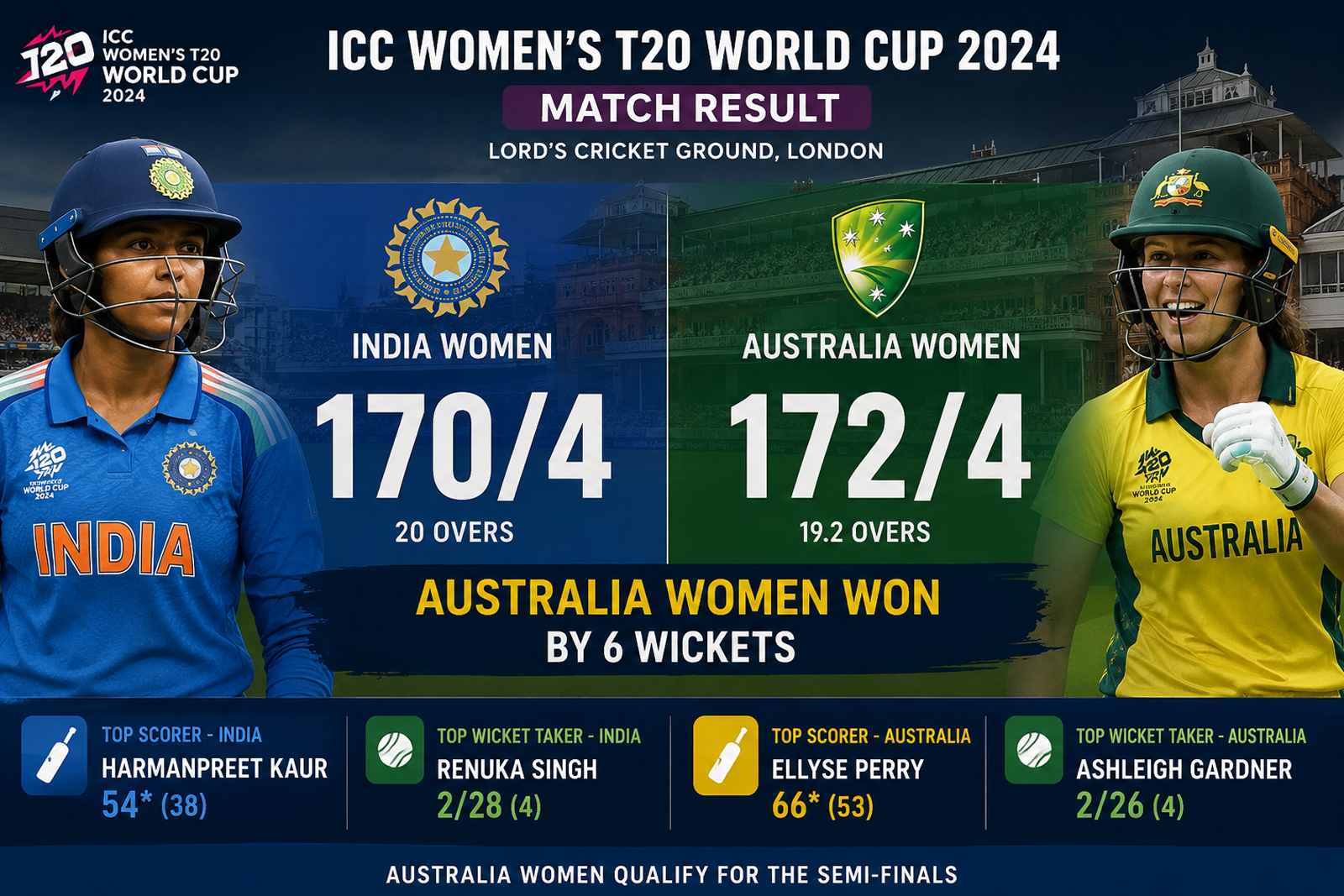
Australia once again showcased why they are among the strongest teams in women's cricket, defeating India by six wickets in a crucial ICC Women's T20 World Cup encounter at Lord's. The victory ensured Australia's progression to the knockout stage, while India's hopes of lifting the prestigious trophy came to an end after a spirited but ultimately unsuccessful performance.
India entered the contest knowing that a win was essential to keep their World Cup campaign alive. The team started with positive intent, looking to post a competitive total against a disciplined Australian bowling attack. However, regular wickets prevented the Indian batters from building long partnerships, making it difficult to accelerate during the middle overs.
Despite the setbacks, India's lower middle order displayed resilience by adding valuable runs in the closing stages. Their efforts helped the team reach a respectable score, giving the bowlers something to defend on a batting-friendly surface.
Australia approached the chase with confidence and patience. Their opening batters laid a strong foundation, rotating the strike effectively while capitalizing on scoring opportunities. Even after losing a couple of wickets, the experienced middle order maintained control of the innings and ensured there were no major setbacks.
India's bowlers fought hard to keep the contest alive, producing a few timely breakthroughs and creating moments of pressure. However, Australia's depth in batting proved decisive as they comfortably crossed the finish line with wickets in hand.
Although the result ended India's World Cup journey, the team produced several encouraging performances throughout the tournament. Young players displayed maturity under pressure, while experienced campaigners continued to contribute with both bat and ball.
The campaign also highlighted areas requiring improvement, particularly converting promising starts into match-winning totals and maintaining consistency during crucial moments. These lessons are expected to help India strengthen its preparations for future international competitions.
With this victory, Australia reaffirmed their reputation as one of the favorites for the ICC Women's T20 World Cup title. Their balanced squad, experienced leadership, and ability to handle high-pressure matches continue to make them one of the toughest teams in world cricket.
As the tournament moves into the knockout stage, Australia will aim to carry this momentum forward, while India will return home determined to build on the positives and come back stronger in future global events.
Australia delivered another commanding performance on the biggest stage, defeating India by six wickets in a decisive ICC Women’s T20 World Cup clash. The victory not only secured Australia's place in the knockout phase but also brought India's campaign to a disappointing end. Played in front of a packed crowd at Lord's, the contest reflected the high standards of women's international cricket, with Australia once again proving why they remain one of the most successful teams in the tournament's history.
For India, the match carried enormous significance. A victory was essential to keep their hopes of winning a maiden ICC Women's T20 World Cup title alive. However, despite moments of promise, the team could not overcome Australia's disciplined bowling attack and composed batting display.
Winning the toss and opting to bat, India looked to make full use of the conditions. The opening pair started cautiously before gradually increasing the scoring rate. The batters focused on rotating the strike while capitalizing on loose deliveries, ensuring the scoreboard continued to move during the powerplay.
Australia, however, quickly settled into their rhythm. Their bowlers maintained excellent line and length, forcing Indian batters to take risks. Sharp fielding and disciplined bowling created constant pressure, making it difficult for India to build the long partnerships required in a high-pressure knockout contest.
Although a few boundaries relieved the pressure temporarily, wickets at regular intervals prevented India from establishing complete control over the innings.
The middle overs proved to be the turning point of India's innings. Australia's spin and pace attack worked in perfect coordination, restricting boundaries while forcing batters into mistakes.
Several Indian players showed glimpses of confidence but failed to convert promising starts into substantial contributions. Every time India attempted to accelerate, Australia responded with a breakthrough.
The disciplined bowling effort ensured India's scoring rate remained under control throughout the innings.
Recognizing the importance of every run, India's lower-order batters displayed determination during the final overs. They rotated the strike effectively, found occasional boundaries, and pushed the total to a competitive level.
Although the final score was not considered massive on a good batting surface, it provided India's bowlers with a target they hoped would create scoreboard pressure.
The late acceleration also demonstrated the fighting spirit within the Indian squad, refusing to surrender despite facing a strong Australian attack.
Australia approached the run chase with remarkable composure. Their opening partnership focused on minimizing risks while steadily collecting runs.
Rather than chasing quick boundaries, Australia's batters emphasized intelligent shot selection and excellent running between the wickets. Their calm approach ensured the required run rate never became a concern.
The opening stand laid the perfect foundation for the middle order.
India's bowling unit refused to give up without a fight. The pace attack generated movement with the new ball, while the spinners successfully slowed the scoring during the middle overs.
A couple of timely wickets briefly shifted momentum, raising hopes among Indian supporters that the match could still turn in their favor.
Fielders also supported the bowlers with energetic efforts, preventing several boundaries and maintaining pressure whenever possible.
Despite these encouraging moments, Australia's experienced batting lineup absorbed the pressure with patience and confidence.
Australia's middle-order batters demonstrated why experience matters in ICC tournaments. Instead of chasing risky strokes, they remained focused on building partnerships and rotating the strike.
As the innings progressed, Australia gradually increased the scoring rate without allowing India any sustained opportunity to dominate.
With calculated aggression and sensible cricket, Australia comfortably crossed the target with six wickets remaining, confirming another memorable victory on the world stage.
Several factors contributed to Australia's success:
Australian bowlers consistently attacked the right areas, limiting scoring opportunities and forcing mistakes from Indian batters.
Sharp catches, quick ground fielding, and accurate throws prevented India from collecting easy runs.
Rather than rushing during the chase, Australia's batters trusted their game plan and executed it with precision.
Every department contributed, highlighting Australia's depth in both batting and bowling.
India showed determination but missed several opportunities that ultimately proved costly.
Regular wickets prevented India from posting the imposing total needed against a strong Australian batting lineup.
Australia successfully restricted India's aggressive stroke play during the crucial middle overs.
Whenever India appeared ready to accelerate, Australia responded immediately with wickets.
Although India claimed important breakthroughs, they could not consistently contain Australia's experienced batters.
Despite the disappointing exit, India's campaign featured several encouraging performances.
Emerging players demonstrated confidence and maturity against world-class opposition, indicating a promising future for Indian women's cricket.
India's bowlers consistently challenged top batting lineups throughout the tournament and displayed fighting spirit until the final over.
Even in difficult situations, the team continued battling and showed resilience under pressure.
With this victory, Australia further established themselves as one of the strongest contenders for the ICC Women's T20 World Cup title.
The team possesses:
These qualities continue to make Australia one of the most feared teams in women's international cricket.
The defeat offers valuable lessons as India prepares for future ICC events.
Key focus areas include:
The experience gained during this tournament will be valuable as India begins preparations for upcoming bilateral series and future global competitions.
Australia now advances to the knockout stage carrying significant momentum and confidence. Their balanced squad, consistent performances, and championship experience make them one of the favorites to lift the ICC Women's T20 World Cup trophy.
For India, the tournament ends in disappointment, but the campaign also highlighted the team's growing strength and depth. While the dream of winning the title will have to wait, the performances of several young players and the team's fighting spirit provide optimism for the future.
As women's cricket continues to grow worldwide, matches between India and Australia remain among the sport's biggest attractions. This latest chapter once again showcased the intensity, skill, and competitive spirit that define one of cricket's greatest rivalries, leaving fans eager for the next encounter between these two powerhouse nations.

In today’s world of endless choices and digital noise, marketing is no longer just about promoting products — it’s about creating meaningful connections. Successful brands focus on building relationships rather than chasing transactions. Marketing that connects transforms audiences into loyal communities by earning their trust, understanding their needs, and delivering genuine value. When businesses prioritize people over promotions, marketing becomes more than strategy — it becomes a relationship built to last.

Odisha’s small businesses are entering a new era — where mobile apps, online payments, and e-commerce aren’t luxuries, but lifelines for growth and survival.

As India enters the second phase of its digital revolution, artificial intelligence and automation are not just transforming industries—they’re redefining what it means to work, earn, and adapt.

The conference brought together officials from ten central districts, including district collectors, tehsildars, registrars, and welfare officers, either virtually or in person.

We glorified sleepless nights, burnout, and exhaustion as signs of ambition. But when did working yourself to the edge become the definition of success?

Not everyone who thrives in tech writes code. Some design the very experiences that make technology human.








Leave Comments